
Alexander Schlosser
Head of Banking & Finance •
Sydney

The Queensland Government has paused the commencement of the next phases rolling out the trust account framework under the Building Industry Fairness (Security of Payment) Act 2017 (BIF Act). Phase 3 and 4, originally scheduled for 1 March 2025 and 1 October 2025, would have expanded the range of eligible construction contracts covered by the framework. Read more about what this means for you in our earlier Alert.
Retention monies can be claimed under the SOP Act – Victoria aligns with its East Coast counterparts
Conflicting case law has meant that Victorian contractors have faced uncertainty about whether they can make a payment claim to release retention moneys under the Building and Construction Industry Security of Payment Act 2002 (Vic) (Victorian SOP Act). That can be contrasted with Queensland and New South Wales, where the SOP legislation in those states explicitly allows contractors to claim retention moneys as part of a payment claim.
Both decisions confirm the Court will engage extensively with the factual circumstances of the case and carefully weigh up the evidence adduced by the parties to determine whether a company has breached the whistleblower protections under the Act. This highlights the importance of:
maintaining robust records (including contemporaneous records) relating to the management of whistleblower matters and any employment processes involving whistleblowers, including decisions to terminate their employment; and
ensuring people involved in making decisions in relation to whistleblower disclosure management and employment processes are ideally separate and distinct, limited in number, and make their decisions lawfully and based on legitimate business reasons.
Although some time has passed since the release of Report 760, as the industry awaits the release of ASIC's public report and given recent ASIC enforcement action against United Super Pty Ltd as trustee for the Construction and Building Unions Superannuation Fund (Cbus) for improper handling of insurance claims, ASIC's investigation of AustralianSuper for delays in paying out insurance claims and APRA's recent action against Cbus,[1] superannuation trustees should revisit the key findings and recommendations made by ASIC in Report 760 and consider their practices and compliance with such requirements.Insurance design and dataASIC noted in Report 760 that the design and delivery of insurance cover requires proper construction to mitigate the risk of members paying for insurance that does not meet their needs and/or paying for cover which they can never claim on. Key areas for improvement included insurance data and design, namely:where superannuation trustees have not already done so, the removal or amendment of restrictive total and permanent disability (TPD) definitions and continual monitoring of member outcomes to ensure members are not being funnelled into restrictive TPD definitions which can negatively impact the ability of members to make successful claims;the need for increased monitoring of member insurance outcomes data to ensure the offered insurance coverage meets members' needs (ie. allows members to make claims when they need to) and provides adequate value for the premiums paid;the need for trustees to review the target market determinations (TMD) of their choice products to ensure they clearly describe the suitable class of consumers in the target market for the product (including for the insurance component of the product, having regard to any eligibility criteria and exclusions that apply to the insurance cover) and include appropriate review triggers; andthe need for regular assessment of the impact of income protection (IP) cover offsets on member outcomes to mitigate the risk of IP offsets resulting in members receiving little to no value from their default IP insurance coverage.
Claims handling practices
Claims handling and settling services have been recognised as a designated financial service under the Corporations Act 2001 since 2021 and claims handling has been an area of focus for ASIC in recent years. While insurers ultimately determine the outcome of claims as the paying entity (albeit trustees have a role checking the insurance policy is being complied with by the insurer), ASIC identified superannuation trustees as playing a crucial role in assisting members in making an insurance claim. Upon reviewing claims handling practices of trustees, ASIC highlighted the following areas for improvement:improved design and delivery of claims processes with members' experience being in front of mind so there is greater transparency of outcomes and a reduction in delays caused by procedural burdens;regular review of complaints and reasons for claims being withdrawn to identify and prepare for issues that members may face in future claims; andincreased oversight of insurers' claims handling processes to ensure they are structured to drive optimal and feasible outcomes for members, including frequent discussion with insurers regarding emerging trends and AFCA compliance.Helping members understand their insuranceASIC also noted that trustees have a duty to help members understand the costs and benefits of their insurance through regular updates so they can make informed decisions. While ASIC noted in Report 760 that trustees have made improvements to their communication strategies and materials, they make a number of recommendations which include (amongst other things):providing clear and balanced member communications to ensure members are able to understand the details of their insurance coverage and any issues (including notice of changes and the impact of such changes) which may influence their decisions in respect to their insurance;proactively communicating key terms and conditions of insurance to members to enable members to make informed decisions, for example, informing members of potential impacts of restrictive TPD definitions where applicable, their assigned occupational category and applicable IP cover offsets on their coverage; andleveraging member data and consumer research to ensure communication processes are optimised for members.Continuing impact of Report 760ASIC's views on insurance in super remain highly relevant, noting recent media coverage of ASIC's investigation into AustralianSuper's remediation of thousands of members where the time taken to pay out insurance claims exceeded the fund's four-month internal standard.Failing to adequately discharge trustee duties can attract significant penalties and ASIC is not hesitating to bring enforcement actions against various superannuation trustees for improper practices including, against:Cbus in 2024 for significant delays in processing insurance claims for over 10,000 members causing an estimated loss of $20 million to members and claimants; andStatewide Super (now part of Hostplus) in 2022 for misleading its members about information relating to their insurance and failing to report breaches to ASIC resulting in a penalty of $4 million.ASIC's focus on member service failures (including poor handling of death benefit claims by superannuation trustees resulting in a significant increase in complaints to AFCA in recent years) has been evident in its enforcement priorities in recent years.The above action taken by ASIC are consistent with its superannuation enforcement priorities concerning member service failures (including extreme processing delays and poor handling of death benefit claims by superannuation trustees which has resulted in a significant increase of AFCA complaints in recent years) and again highlights ASIC's growing oversight of insurance in super.Trustees should also be aware that the Government is seeking to introduce mandatory and enforceable service standards for super funds. The proposed standards intend to target:timely and compassionate handling of death benefits;fair and efficient processing of insurance claims; andclear, respectful and accessible communications with members.As regulatory pressures rise, superannuation trustees should be looking to improve their claims handling practices and align themselves with ASIC expectations to avoid investigative and/or enforcement action.If you would like to further discuss the implications of ASIC's recommendations in Report 760 on your business or require assistance with any superannuation-related queries, please contact us.
The IMO, a United Nations specialised agency, has responsibility for the safety and security of international shipping, and the prevention of marine and atmospheric pollution by ships. Its work includes international law reform initiatives, such making regulations covering liability and compensation for damage, such as pollution, caused by ships.
The IMO's development and reform agenda responds to the UN's Sustainable Development Goals. Building on its early work establishing the first ever comprehensive antipollution convention, the 1973 International Convention for the Prevention of Pollution from Ships (MARPOL Convention), these regulations now include added requirements addressing pollution from chemicals, other harmful substances, garbage, sewage and – under an Annex VI adopted in 1997 – air pollution and emissions from ships.
The first mandatory international measures to improve energy efficiency for ships was issued on 15 July 2011. These introduced controls including the International Air Pollution Prevention Certificate and the International Energy Efficiency Certificate regimes. Further progress was made through the 2018 Initial IMO GHG Strategy and the 2023 Strategy on Reduction of GHG Emissions from Ships.
The IMO's most recent set of "short term" technical and operational measures, the Energy Efficiency Existing Ship Index (EEXI) and the Carbon Intensity Indicator (CII), have been in force since 1 January 2023.
Existing ships of 400 GT and above must calculate their attained Energy Efficiency Existing Ship Index (EEXI), which reflects the "technical" or "design" efficiency of the ship. (The IMO will be reviewing the effectiveness of the EEXI requirements during 2025.)
Ships then have to reach a "required EEXI", equivalent to the Required Energy Efficiency Design Index levels for new vessels for 2022 — a technical efficiency measure for ship design, based on a minimum energy efficiency level per capacity mile (eg. tonne mile) for different ship types and sizes.
The EEXI framework is technology (including fuel-type) neutral: the shipowner or charterer can choose the most appropriate means to achieve the goals set by IMO regulations.
This reflects the operational energy efficiency of ships, building on baselines set by previous fuel oil consumption regimes. It is mandatory for ships of 5,000 gross tonnage and above.
Attained annual operational CII must be documented and verified against the required annual operational CII for a ship. The annual carbon intensity reduction factor is equivalent to business-as-usual until entry into force, then 2% from 2023 to 2026, and finally to be further strengthened for the period 2027 to 2030.
The ship's operational carbon intensity rating must be states on a performance level scale of A (major superior), B (minor superior), C (moderate), D (minor inferior) or E (inferior). A ship rated D for 3 consecutive years or rated as E must develop a "Plan of corrective actions".
Fuel type and efficiency is a material component of the CII rating.
Figure 1 – IMO summary of EEDI, EEXI and CII requirements under MARPOL Annex VI
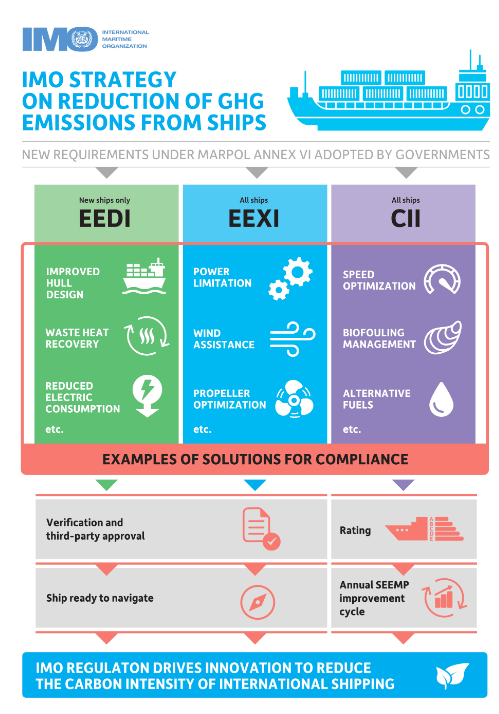
The 2023 IMO GHG Strategy sets ambitious targets to reduce GHG emissions in international shipping, emphasising technological innovation and alternative fuels.
Key goals include:
Carbon intensity reduction – Improving energy efficiency for new ships and reduce CO₂ emissions per transport work by at least 40% by 2030, compared to 2008 levels.
Adoption of Low / Zero-Emission Technologies – By 2030, at least 5% (striving for 10%) of shipping energy use should come from zero or near-zero GHG emission sources.
Net-Zero Emissions by 2050 – Emissions should peak as soon as practicable, and reach net-zero by 2050.
Indicative interim checkpoints – Cutting total annual GHG emissions by 20-30% by 2030, and by 70-80% by 2040, compared to 2008 levels.
In the medium term, the IMO has indicated that "a basket of candidate measure(s), delivering on the reduction targets, should be developed and finalised, comprised of both:
Because the IMO is taking a regulatory approach which is technology and fuel-type agnostic, and focusses instead on emissions intensity, it is not setting specific targets for the use of particular fuel types. However, it can be reasonably anticipated that, over time, the approach will be effective in moving shipping fleets from using emissions intense fuel types such as heavy fuel oil, very low sulphur fuel oil and marine diesel to fuels that have a higher energy profile and lower emissions intensity, such as LNG, methanol, ammonia and hydrogen.
Many shipping companies, particularly those with a European operations base, have already started down a comparable path of GHG emissions reductions as a result of the EU's Monitoring, Reporting and Verification Maritime Regulation and the scheduled progressive coverage of the European Emissions Trading Scheme to cargo and passenger ships.
The IMO 2023 GHG Strategy includes a timeline for adoption of these mid-term measures:
Northern Spring 2025: approval of mid-term measures;
Northern Autumn 2025: adoption of mid-term measures at an extraordinary session of the Marine Environment Protection Committee; and
2027 (16 months after adoption): entry into force of mid-term measures.
The IMO initially released a preliminary "illustration" of a possible draft outline of an "IMO net-zero framework", listing regulations under the International Convention for the Prevention of Pollution from Ships (MARPOL) to adopt or amend to allow for a new global fuel standard and a new global pricing mechanism for maritime GHG emissions.
The illustration identifies the following possible amendments to MARPOL Annex VI in a new Chapter 5 entitled "Regulations on the IMO net-zero framework":
New Chapter 5.1: Goal-based marine fuel standard regulating the phased reduction of the marine fuel’s GHG intensity — with specific new regulations covering its application, goals, functional requirements, attained GHG fuel intensity (GFI), target / required GFI; GFI data collection and reporting; alternative compliance approaches; and a central GFI Registry.
New Chapter 5.2 - Economic mechanism(s) to incentivize the transition to net-zero – with new regulations for application, calculation of economic contribution by ships, collection of economic contribution by ships, flexible compliance mechanism(s), central management / oversight of collected revenue, and distribution of revenue.
At the MEPC 82 meeting, possible draft amendments to MARPOL Annex VI on the net-zero framework (MEPC 82/WP.9, annex 1) were presented as "a work in progress", and this document continue to be evaluated by the IMO Secretariat, expert working groups and member States in advance of the further deliberations schedule for 2025.
However, some notable aspects of the working draft include:
Well-to-wake scope – The regulations will be based on reported, verified and determined "well-to-wake" GHG emissions produced by the fuel used on board the ship.
Scaled reduction factors – The regulations will set out prescribed reduced factors with dates by which the annual GFI of a ship must be reduced with reference to the GFI reference value, with "base" and "strive" targets.
Emissions pooling – An annual GFI over-compliant ships are to be permitted to pool their surplus compliance units with excess emissions from under-compliant ships, to achieve an overall pool compliance balance of zero.
Financial contributions to IMO Net Zero Fund – A new Fund will be established and ships will be required to make an annual GHG fuel contribution, based on the amount of its GHG emissions multiplied with a contribution rate per tonne of CO2eq as determined by the MPEC, on a well-to-wake basis to be defined in the guidelines to be developed by the IMO.
Statement of Compliance – Will be used as the primary document in which annual GHG fuel intensity and the corresponding GHG fuel contribution to the fund is evaluated.
GFI Registry – A central GFI Registry administered by the IMO will be the record keeper and administrator for both individual and pool data.
Enforcement alternatives – May include either or both of requirements to bring Statements of Compliance into order and / or the imposition of additional charges or the detention of ships by a Port State until compliance is demonstrated.
Legal updates and articles on the topics that matter to you, sent as they happen.
Subscribe[1] [1] APRA announced on 10 February 2025 that it had accepted a court enforceable undertaking from Cbus which seeks to address (among other issues) APRA's concerns regarding Cbus' operational risk management framework having observed insurance claims processing delays and insurance administration incidents (including incorrect provision of insurance cover, failure to provide insurance cover where required/requested and overcharging/undercharging of insurance premiums). As a result of this action, Cbus will be required to undertake a holistic risk transformation program to rectify any shortcomings which further highlights the consequences of failing to meet ASIC and APRA expectations and standards Back to article